文章信息 | Integrated surface display and atp regeneration for efficient butyrolactam biosynthesis in Escherichia coli, Biochemical Engineering Journal, 2026. | 作者 | Xiangcao Cui, Xiaosen Liu, Huiling Zhang, Kun Zhou, Cunzhuo Tang, Chen Deng, Xu Li, Yongjun Qiu, Liqiang Fan*, Liming Zhao* | 摘要 | Butyrolactam is a high value-added monomer and an important intermediate for various physiologically active substances, and has been widely used in the pharmaceutical, pesticide, and chemical industries. Though the biosynthesis of butyrolactam is gradually advancing, challenges such as the requirement for expensive cofactor adenosine triphosphate (ATP) and the barrier of substrate transmembrane transport in whole-cell synthesis hinder its large-scale industrial application. In this study, an integrated whole-cell catalytic strategy combining ice nucleation protein (INP)-mediated surface display and ATP regeneration was developed. Compared with the butyrolactam productivity of cells intracellularly expressing β-alanine CoA transferase (ACT), co-expressing polyphosphate kinase 2 (PPK2) to regenerate ATP and display ACT on the cell surface only increased it by 23.1% and 25.0%, respectively. Co-displaying ACT and PPK2 further increased the butyrolactam productivity, which was 46.4% more than that of only ACT displayed cells. Using fed-batch fermentation strategy, a final butyrolactam titer of 39.13 g/L and a yield of 94.7% were achieved in the strain co-displaying ACT and PPK2. Our findings demonstrate a potentially attractive strategy for the industrial butyrolactam production. | 摘要图 | 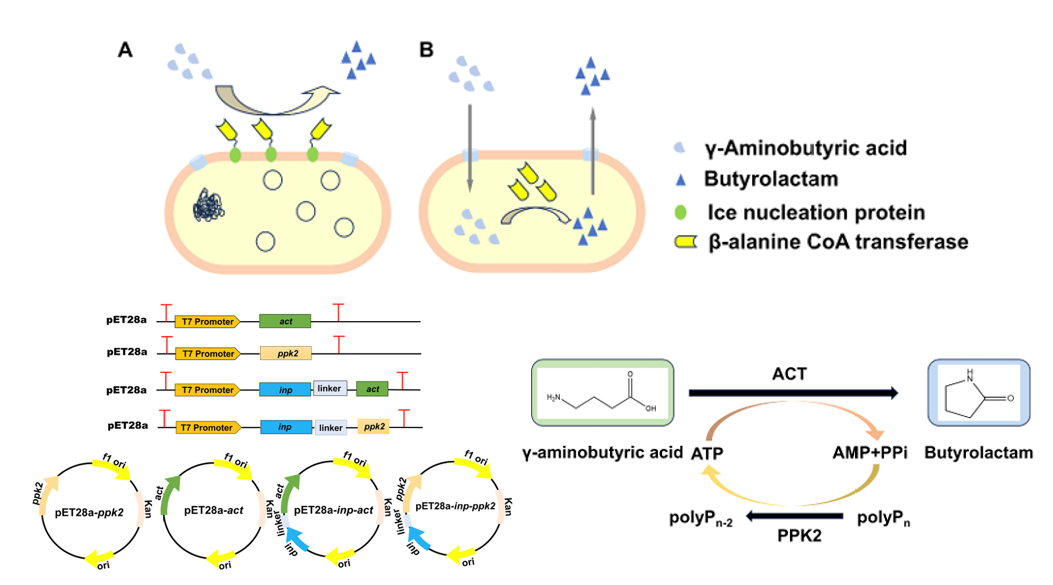
| 文章主页 |
|
|