作者 | Xiaoxuan Lu, Jiaqi Zou, Geng Han, Mengyao Zhao, Ting Luo, Xiangru Feng, Liangliang Zhu, Yijia Chen,Xiaoguo Ji*, Jiayang Jin*, Liming Zhao*. |
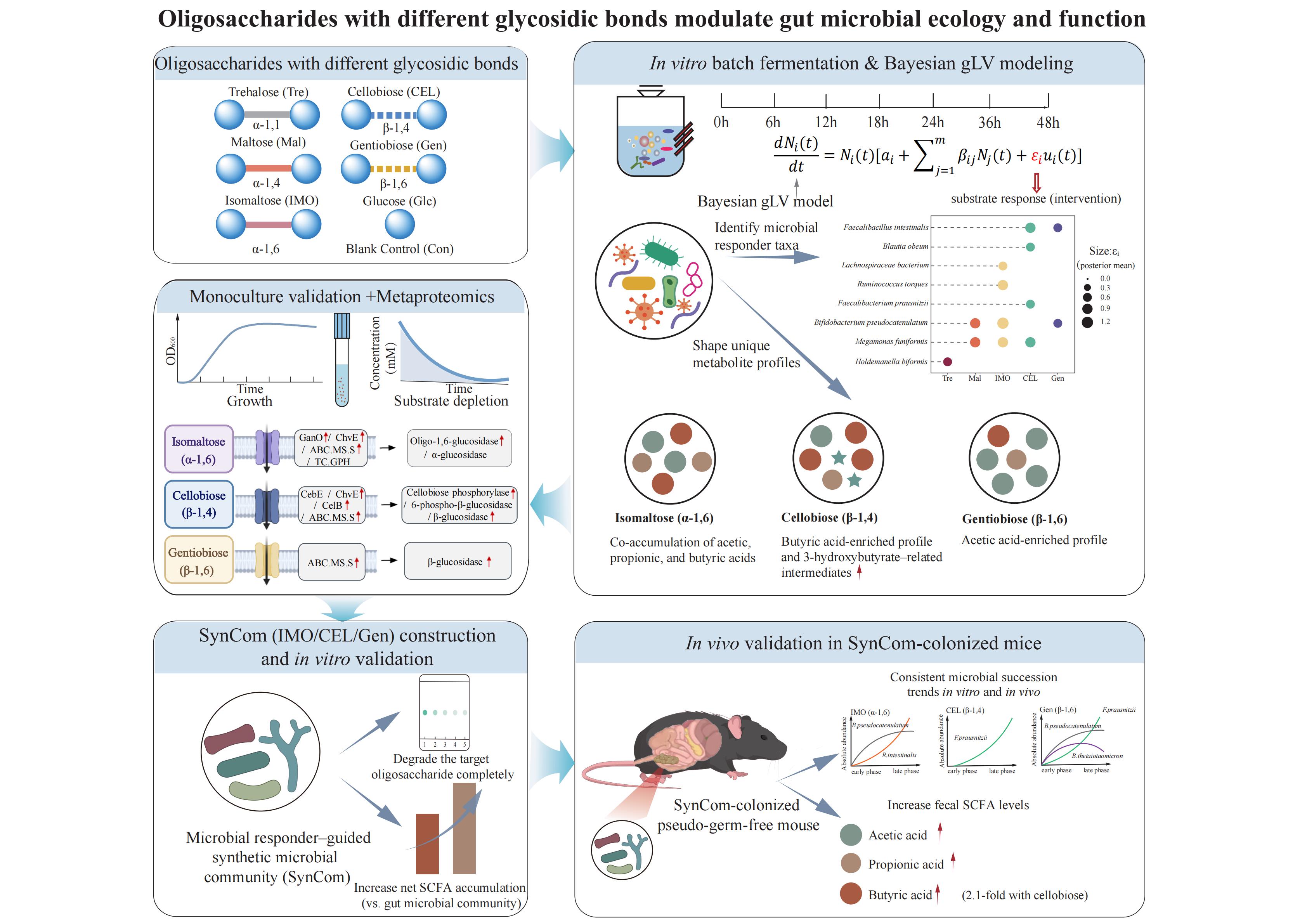
摘要 | Functional oligosaccharides play an important role in shaping the gut microbiota, and their effects depend on monosaccharide composition, degree of polymerization, and glycosidic linkage type. Previous studies have shown that different oligosaccharides induce distinct microbial communities and metabolic profiles. However, natural oligosaccharides often differ in several structural features, making it difficult to isolate the effects of glycosidic linkages. Moreover, most studies focus on microbial composition at the end of fermentation, overlooking early responders that may decline later due to microbial competition or metabolic cross-feeding. In this study, five glucose-based disaccharides with different glycosidic linkages were selected: trehalose (α-1,1), maltose (α-1,4), isomaltose (α-1,6), cellobiose (β-1,4), and gentiobiose (β-1,6). All five share the same monosaccharide composition and degree of polymerization but differ in linkage configuration and position. In vitro anaerobic fermentation revealed distinct patterns of microbial succession. α-linked disaccharides mainly promoted the growth of Bifidobacterium pseudocatenulatum and Megamonas funiformis, while cellobiose favored the expansion of Faecalibacterium prausnitzii during the middle and late fermentation stages. Gentiobiose primarily stimulated B. pseudocatenulatum. These microbial changes were accompanied by different short-chain fatty acid (SCFA) profiles, with gentiobiose favoring acetate accumulation and cellobiose producing the highest butyrate levels.A Bayesian generalized Lotka-Volterra (gLV) model was built using absolute abundance time-series data to identify glycosidic linkage-specific microbial responders while accounting for microbial growth, interspecies interactions, and substrate responses. Monoculture experiments confirmed that representative responders could directly utilize the corresponding disaccharides. Metaproteomic analysis further revealed the expression of substrate recognition, transport, and hydrolysis proteins consistent with their preferred glycosidic linkages. Together, these findings provide new insights into how glycosidic linkage structures influence microbial substrate utilization and community succession, offering a basis for the structure-guided design of functional oligosaccharides and targeted modulation of the gut microbiota. |